
We talk a lot about the case for a holistic, whole-house approach to retrofit: insulation, airtightness, ventilation, shading, heating and cooling all designed to work together rather than being bolted on one at a time. It’s easy to say. So we decided the only honest way to make that case was to put our own home through exactly the process we recommend to clients.
What We Did
We didn’t pick one measure and stop there. Our retrofit covered:
- Added insulation to cut heat loss through the fabric.
- Improved airtightness, so the insulation could actually do its job without warm (or cool) air leaking away.
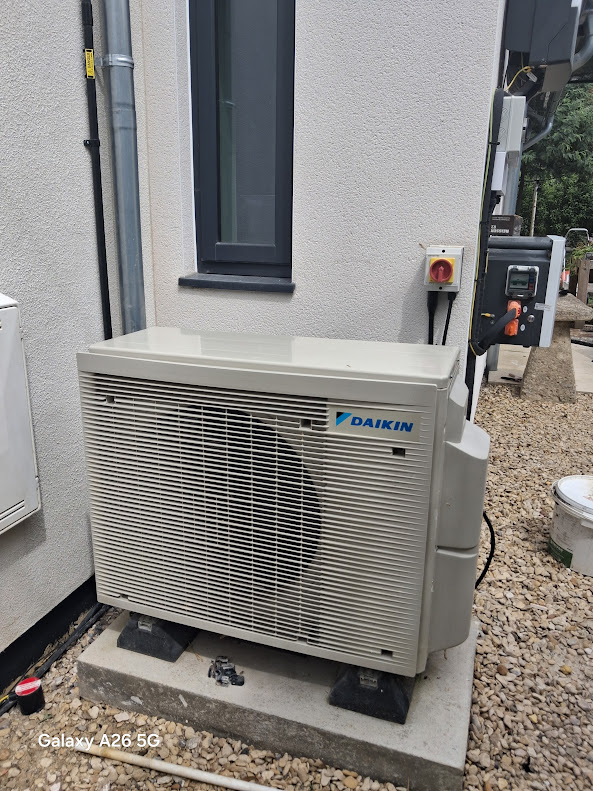
- An air-to-air heat pump, rather than a standalone air conditioning unit — giving us efficient heating in winter and cooling in summer from a single, reversible system.
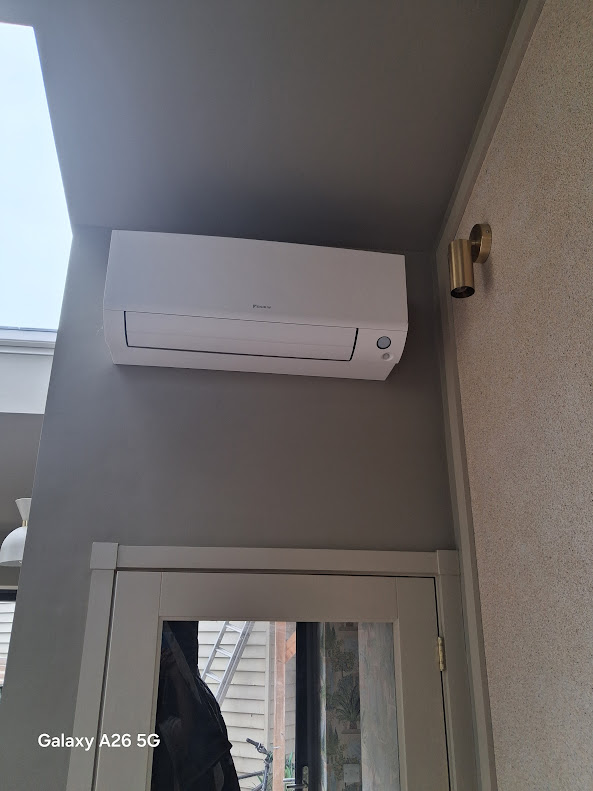
The indoor unit — discreet, wall-mounted, and providing both heating and cooling from a single system.
The outdoor unit, sited on a level base against the wall.
- Solar PV with battery storage, to generate and store our own low-carbon electricity rather than simply shifting our energy use onto the grid. As a bonus we hadn’t fully appreciated going in, the panels themselves shade the roof beneath them — research measuring this effect has found panels can cut the heat reaching the roof by around a third, so the same installation that’s decarbonising our electricity is also passively reducing roof overheating.
None of these measures were treated as a stand-alone upgrade. They were planned together, precisely because insulation without ventilation can cause problems, and cooling without efficient generation just moves your costs around rather than cutting them.
The Result
Because we reduced both heat demand and cooling demand at the same time — rather than solving one and creating pressure on the other — our July energy bill was in credit. Not reduced. In credit.
That’s the practical payoff of a genuinely whole-house approach: the insulation and airtightness that keep the house warm in winter are the same measures that reduce the cooling load in summer, and with solar PV and battery storage generating and storing power alongside a heat pump doing double duty as heating and cooling, the house is working with the weather rather than fighting it in both directions.
Why This Matters
It’s one thing to recommend a holistic retrofit to clients. It’s another to have lived through the planning decisions, the sequencing questions, and the trade-offs ourselves — in our own home, with our own money, under the same UK weather everyone else deals with.
We believe in sustainability and retrofit as the right approach for the industry. But we’ve also tested it on the building we know best. If you’re weighing up where to start with your own home — whether the priority is a cold room in winter or an unbearable one in summer — we’re happy to talk through what a whole-house approach could look like for your property, based on what’s actually worked for us.